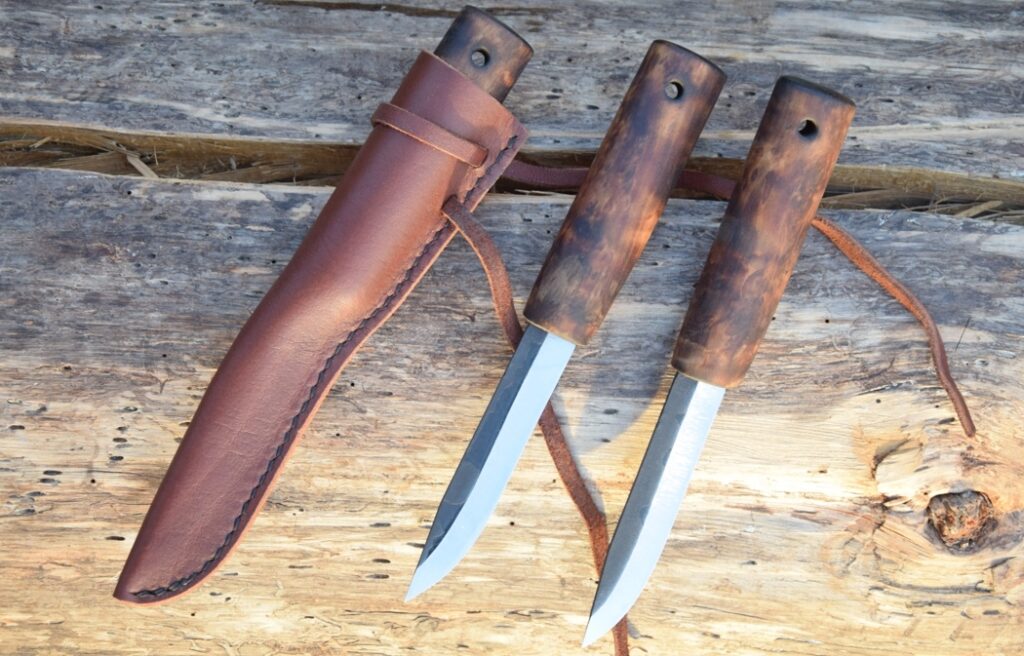
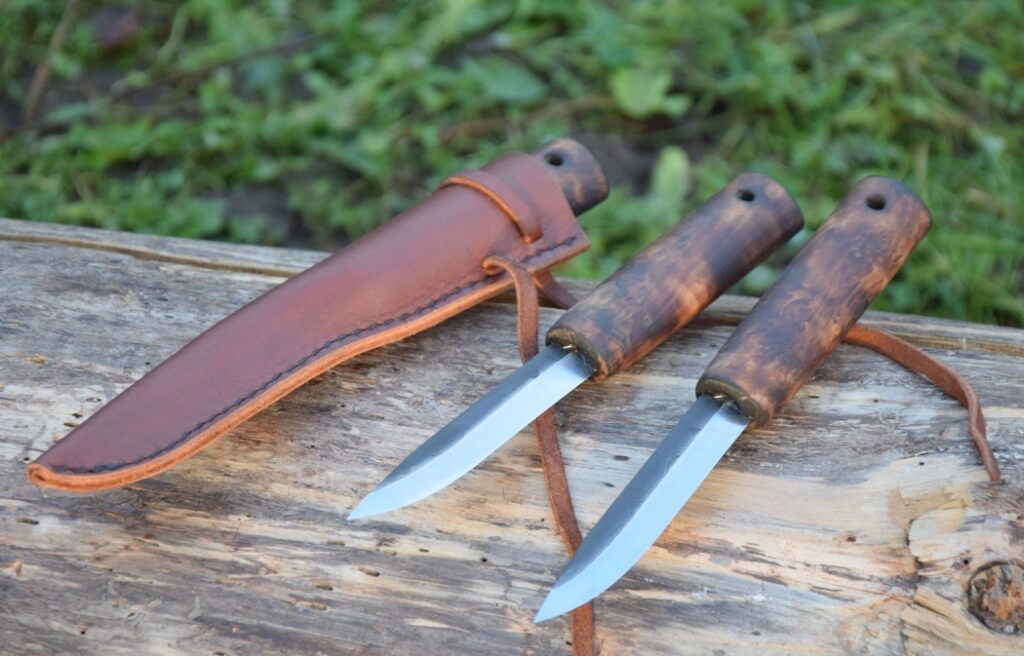
The citizens of medieval Turku (Finland) dumped a lot of waste in their city. The waste preserved the leather artifacts, allowing us to find nearly two hundred medieval knife sheaths. Their simplicity and functionality have inspired me. Therefore, I have made a batch of knives with a sheath that was once common in Turku (17 found). The selected sheath type has a side seam and two holes for suspension. The reconstructed suspension design is somewhat of a guesswork because the original loops were made of a material, perhaps linen, that did not survive. Linen or cotton is stronger than leather, but despite that I chose the leather strap because it looks great. This hanging arrangement works especially well when a right-handed person carries the knife on their left side.
A village smith style puukko resembles ancient knives and matches perfectly with the sheath. The handle has a hole for a lanyard. Many ancient Finnish knives had a metal ring on the end of the handle, and some had a drilled hole. However, the hole is not typical for puukkos. The blade used is a high-end puukko blade, while ancient knife blades were usually softer and had a blade-wide bevel.
A long blade and the absence of a finger guard can be risky. Also, the sheath is dangerous because, like its ancient counterparts, it has only 2 mm thick leather and no liner. Furthermore, you may accidentally cut the side seam due to the absence of a welt. For these reasons, this puukko is only for careful and experienced users.
Blade: 80CrV2, edge-hardened (edge 62 HRC, spine 34 HRC), length 105 mm, JSP stamped on spine. Handle: Curly Birch, torched, oiled with boiled linseed oil. Sheath: vegetable tanned leather, 2 mm, hand-stitched. Price: 85 EUR
Click here to see a YouTube video about the puukko made by Kawka w lesie